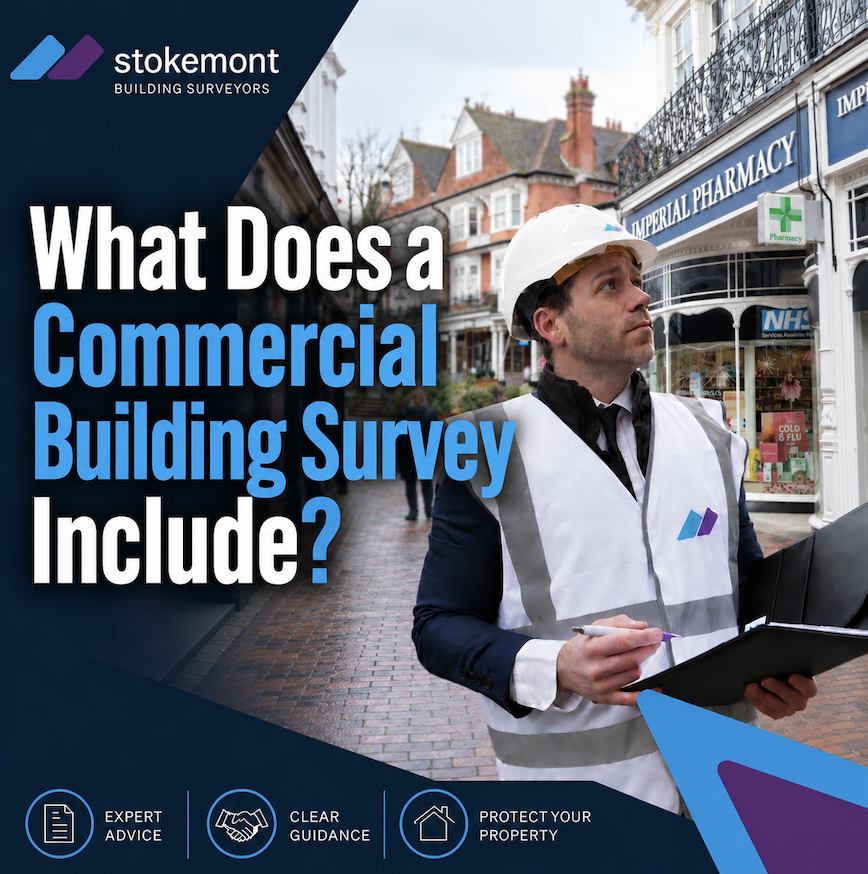
Buying a commercial property can represent a significant financial commitment.
The purchase price is only one part of that commitment. Roof replacement, structural repairs, water ingress, defective finishes, outdated services and historic maintenance issues can quickly result in substantial additional expenditure after completion.
A Commercial Building Survey is designed to give the purchaser a detailed understanding of the property before they become legally committed to it.
At Stokemont, our role is not simply to identify defects. We aim to explain what those defects mean, how significant they are and what is likely to be required to address them.
What Does the Surveyor Inspect?
The precise scope will depend upon the building, its construction and the agreed terms of instruction.
Generally, the surveyor will inspect the reasonably accessible external and internal parts of the property.
Externally, this is likely to include:
- Roof coverings
- External walls
- Windows and doors
- Rainwater goods
- External finishes
- Parapets and roof-level details
- Accessible external areas
Internally, consideration will normally be given to walls, floors, ceilings, structural elements, finishes and evidence of defects such as cracking, dampness, movement or water penetration.
Roofs Can Be Particularly Important
Commercial roofs can represent one of the building’s largest future liabilities.
Flat roof coverings, profiled metal systems, gutters, drainage outlets and rooflights can all require significant maintenance or replacement.
A roof does not necessarily need to be leaking at the date of inspection to represent a future cost.
Its age, condition and likely remaining serviceable life can be equally important to a purchaser.
What About Building Services?
A Building Surveyor will generally make observations on the visible building services, but a Commercial Building Survey should not be confused with specialist mechanical and electrical testing.
Depending upon the property, further input from an electrical engineer, mechanical engineer, drainage specialist, lift consultant or other professional may be recommended.
Identifying where further investigation is needed is itself an important part of the surveying process.
Future Maintenance and Expenditure
A good Commercial Building Survey should not simply tell you what is defective today.
It should also help you understand foreseeable maintenance liabilities.
Windows may currently function but require overhaul. External decorations may shortly be due. Roof coverings may be approaching the end of their economic life.
These issues can become particularly important when purchasing an investment property where future expenditure needs to be understood as part of the wider acquisition.
Our Purchase & Acquisition services can also assist clients in considering property-related risks as part of the wider transaction.
Is It the Same as a Schedule of Condition?
No. A Commercial Building Survey principally provides advice on the building and its condition.
A Schedule of Condition is primarily intended to create a detailed written and photographic record of a property at a particular point in time.
While there can be some overlap in the inspections, the purpose of the reports is different.
Can the Survey Help With Negotiations?
Potentially. Where significant defects are identified before completion, purchasers may wish to discuss the findings with their solicitor and property agent.
That could result in further investigation, works being undertaken before completion or a commercial renegotiation.
Ultimately, the purpose of the survey is to ensure that the purchaser is making the decision with their eyes open.
Stokemont Commercial Building Surveys
At Stokemont, we regularly inspect offices, retail premises, restaurants, warehouses, mixed-use properties and commercial investment buildings across London.
Our reports are designed to be technically detailed while remaining clear and practical.
If you are considering purchasing a commercial property, request a quotation from Stokemont and we will confirm the appropriate survey scope, fee and anticipated timescale.