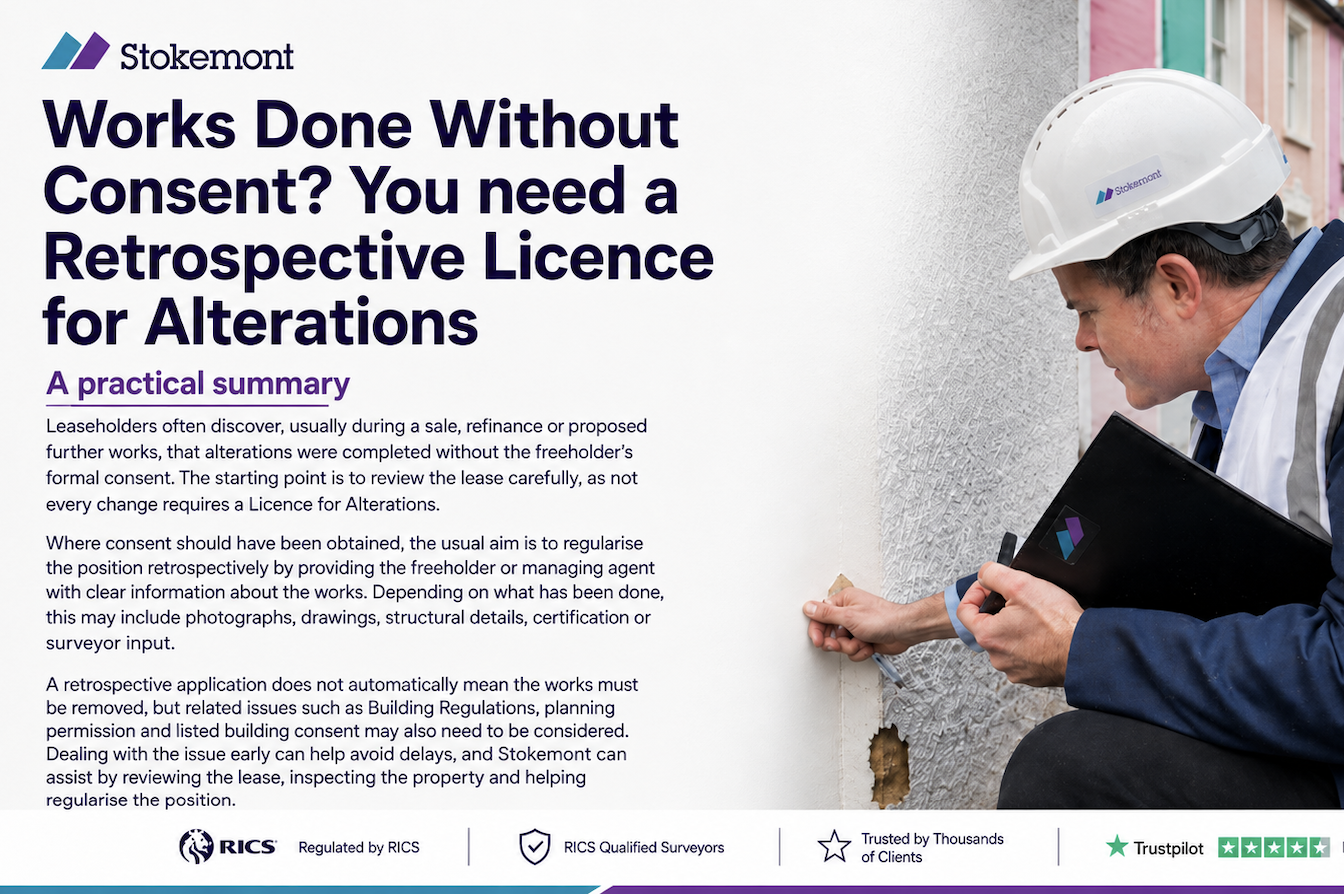
It is surprisingly common for leaseholders to discover that alterations carried out to their property did not receive the freeholder’s formal consent.
Sometimes the works were completed by a previous owner. In other cases, the leaseholder may simply not have realised that permission was required before undertaking what appeared to be relatively straightforward refurbishment works.
The issue often only comes to light when the property is being sold, refinanced or further alterations are proposed.
At Stokemont, we regularly assist leaseholders with Licence for Alterations matters, including retrospective applications where works have already been completed.
The objective is generally straightforward: establish what has been altered, understand what the lease requires and determine what information the freeholder is likely to need in order to regularise the position.
Start With the Lease
The first step should always be to review the lease.
Not every alteration requires freeholder consent, and leases can differ considerably in the restrictions they place upon leaseholders.
Some leases principally restrict structural alterations, whereas others go considerably further and can control changes to floors, services, internal layouts, windows, plumbing and other elements of the property.
For this reason, the fact that works have taken place does not automatically mean that there has been a breach of the lease.
The wording of the lease should be considered alongside the actual scope of the works undertaken.
What Happens if Consent Should Have Been Obtained?
Where consent was required but was not obtained, the usual objective is to regularise the position retrospectively.
This commonly involves approaching the freeholder or managing agent and providing sufficient information for their surveyor and legal advisers to understand the alterations.
The level of information required will depend heavily upon the works.
For straightforward refurbishment, photographs and a clear written description may be sufficient. More significant alterations may require architectural drawings, structural calculations, Building Control information, electrical certification, gas certification or other supporting documents.
Where historic works are involved and drawings are no longer available, a Building Surveyor can often inspect the property and help establish a clear record of what has actually been undertaken.
Will the Works Have to Be Removed?
Not necessarily.
A retrospective application does not automatically mean that the freeholder will require the property to be returned to its previous configuration.
The position will depend upon the lease, the nature of the alteration and whether the works have adversely affected the structure, common parts or neighbouring properties.
The freeholder may simply require satisfactory evidence that the works have been appropriately undertaken.
Where there are concerns about the physical condition of the completed works, a more focused Defect Analysis inspection may also be appropriate.
Building Control Is a Separate Issue
A Licence for Alterations and Building Regulations approval are two separate matters.
Receiving retrospective consent from the freeholder does not necessarily regularise a Building Control issue. Equally, having Building Regulations approval does not automatically satisfy the requirements of the lease.
Where there is uncertainty, Building Control input may be required to establish whether approval should have been obtained and, if so, what retrospective procedure may now be appropriate.
The same principle can apply to planning permission and listed building consent.
Why Deal With the Issue Early?
Unauthorised alterations have a habit of becoming a problem at the least convenient time.
They are often discovered during a sale when the purchaser’s solicitor asks for the original Licence for Alterations.
At that stage, delays can arise while historic information is gathered, the freeholder appoints advisers and the works are reviewed.
If you already know alterations have been undertaken without formal consent, there can therefore be a significant advantage in dealing with the matter before a sale or refinancing is underway.
How Can Stokemont Help?
At Stokemont, we take a practical approach to retrospective Licence for Alterations matters.
We can review the available information, inspect the property, establish the scope of the historic alterations and liaise with the relevant managing agent, freeholder and wider professional team.
Our aim is to understand what has happened, establish what further information is reasonably required and work towards regularising the alterations as efficiently as possible.
If you have discovered historic alterations without formal consent, contact the Stokemont team to discuss how we can assist.