
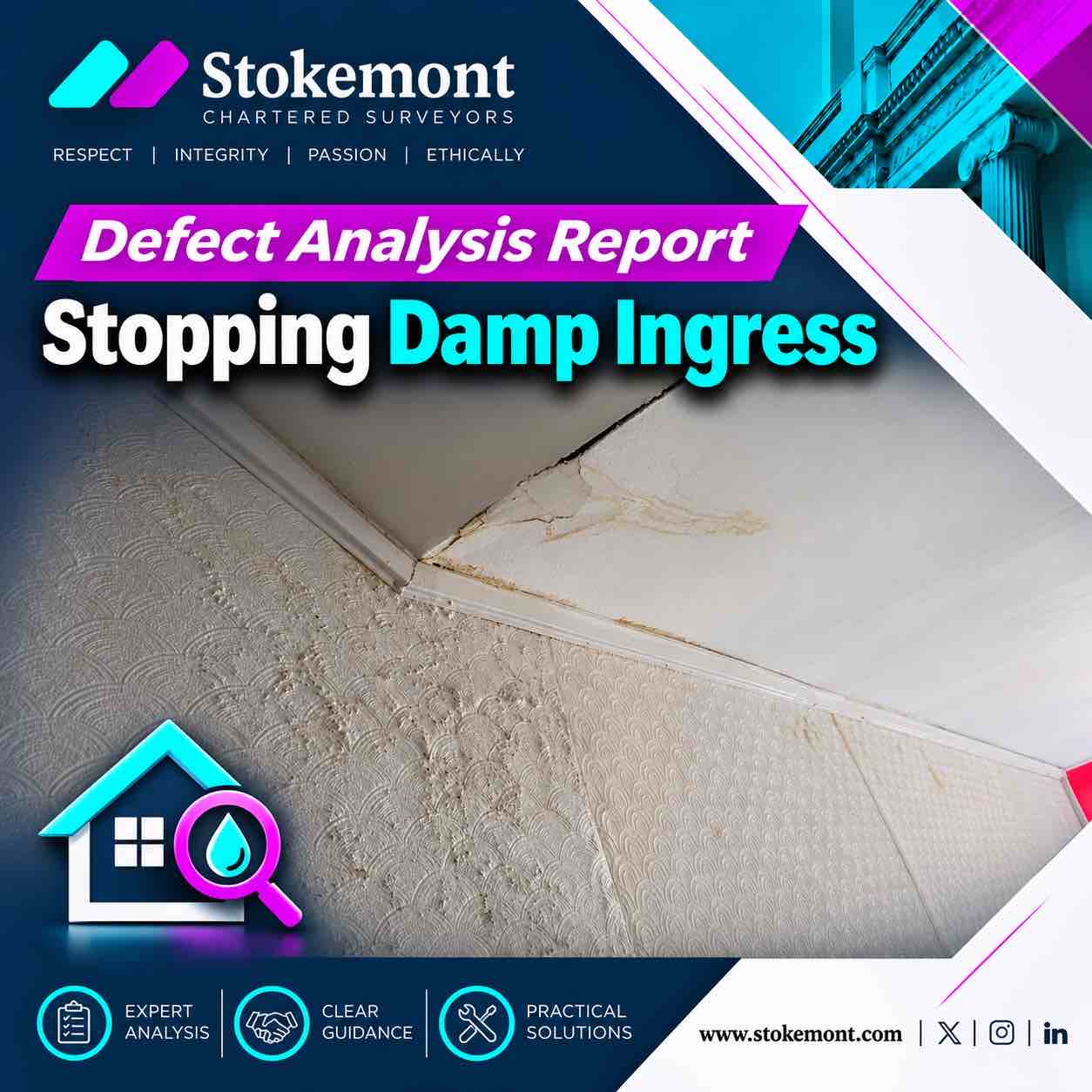
Damp staining, blistered finishes and damaged plaster are often the first visible signs of water ingress. But the place where the damage appears is not always where the problem begins.
Water can travel through walls, floors, service routes and concealed voids before becoming visible. That is why simply repairing the damaged finish can be ineffective. If the source remains unresolved, the damp is likely to return.
A Defect Analysis Report is designed to identify the likely cause of the problem and set out what should happen next.
Finding the Cause, Not Just the Damage
A focused defect investigation starts with the affected area.
The surveyor will look at the pattern of staining, deterioration to finishes and the position of the damage within the building. Moisture testing can then help establish whether the affected surfaces are still damp or whether the staining relates to an older issue.
Professional moisture meters, photographic records and accurate measurements can all form part of this process.
The important point is that the investigation should not stop with what can immediately be seen.
Tracing Water Ingress Through the Building
Once moisture has been confirmed, the next step is to consider where it could be coming from.
Depending on the building, possible sources might include:
- defective drainage pipes;
- leaking plumbing;
- roof or terrace drainage;
- failed gutters or rainwater goods;
- bathrooms and kitchens above;
- external defects; or
- concealed pipework within walls and voids.
Measurements can be particularly useful when the suspected defect is located above, below or beside the area showing signs of damp.
By comparing the position of the damage with drainage routes and other building elements, a surveyor can begin to narrow down the likely cause.
Why Hidden Areas Can Matter
One of the challenges with water ingress is that the source may be concealed.
A wall might show staining at ground-floor level while the actual failure is within a basement, service void or drainage run nearby.
Where appropriate access is available, inspecting these adjoining areas can reveal evidence that would otherwise remain hidden.
For example, heavily corroded drainage pipework can eventually split and allow water to escape into the surrounding structure. A significant pipe failure may then cause dampness some distance away from the visible defect.
This is why a thorough investigation looks at how the building fits together rather than treating each damp patch in isolation.
Testing the Likely Source
Where it is safe and practical, the suspected cause can sometimes be tested.
If defective drainage is suspected, for example, water may be introduced through the relevant drainage route while the area below is monitored.
If water then escapes from the damaged pipe or appears within the affected area, this provides much stronger evidence of the cause than visual inspection alone.
In one such investigation, water introduced through the drainage system was observed escaping through a failed pipe and saturating the surrounding area.
Repair the Source Before Redecorating
Once the cause of the water ingress has been identified, the priority should usually be to repair the underlying defect.
There is little benefit in replacing wallpaper, repainting walls or repairing plaster if water is still entering the building.
Where drainage pipework has become heavily corroded or split, replacement may be required rather than a cosmetic repair. If the pipe is positioned within a difficult or concealed location, the works may also require a specialist contractor.
The affected building fabric should then be allowed sufficient time to dry before final reinstatement and decoration are carried out.
Why a Defect Analysis Report Can Save Time and Cost
Without identifying the root cause, property owners can end up paying for the same problem more than once.
A contractor may repair the visible damage, only for the damp to reappear because the original source was never addressed.
A Defect Analysis Report helps provide a more structured starting point by identifying the likely defect and explaining the remedial steps that should be considered.
It can also help when obtaining contractor quotations because the problem is more clearly defined.
For larger remedial works, obtaining several quotations is generally sensible so that the proposed scope and cost can be compared.
How Stokemont Can Help
At Stokemont, our Defect Analysis Surveys focus on investigating specific building problems and providing clear, practical guidance on the likely cause and next steps.
Depending on the circumstances, our inspection may include:
- visual assessment;
- moisture testing;
- measurements;
- photographic records;
- investigation of accessible adjoining areas;
- consideration of drainage and service routes; and
- recommendations for appropriate remedial action.
Our aim is to help clients move from uncertainty to a clearer understanding of the problem and what needs to be done to resolve it.
Get an Instant Quote
If you are dealing with damp, water ingress or another unexplained building defect, Stokemont can provide a focused Defect Analysis Survey.
Use our Instant Quote service to check pricing and expected turnaround times before instructing us.
Get an Instant Quote today and arrange your inspection.


