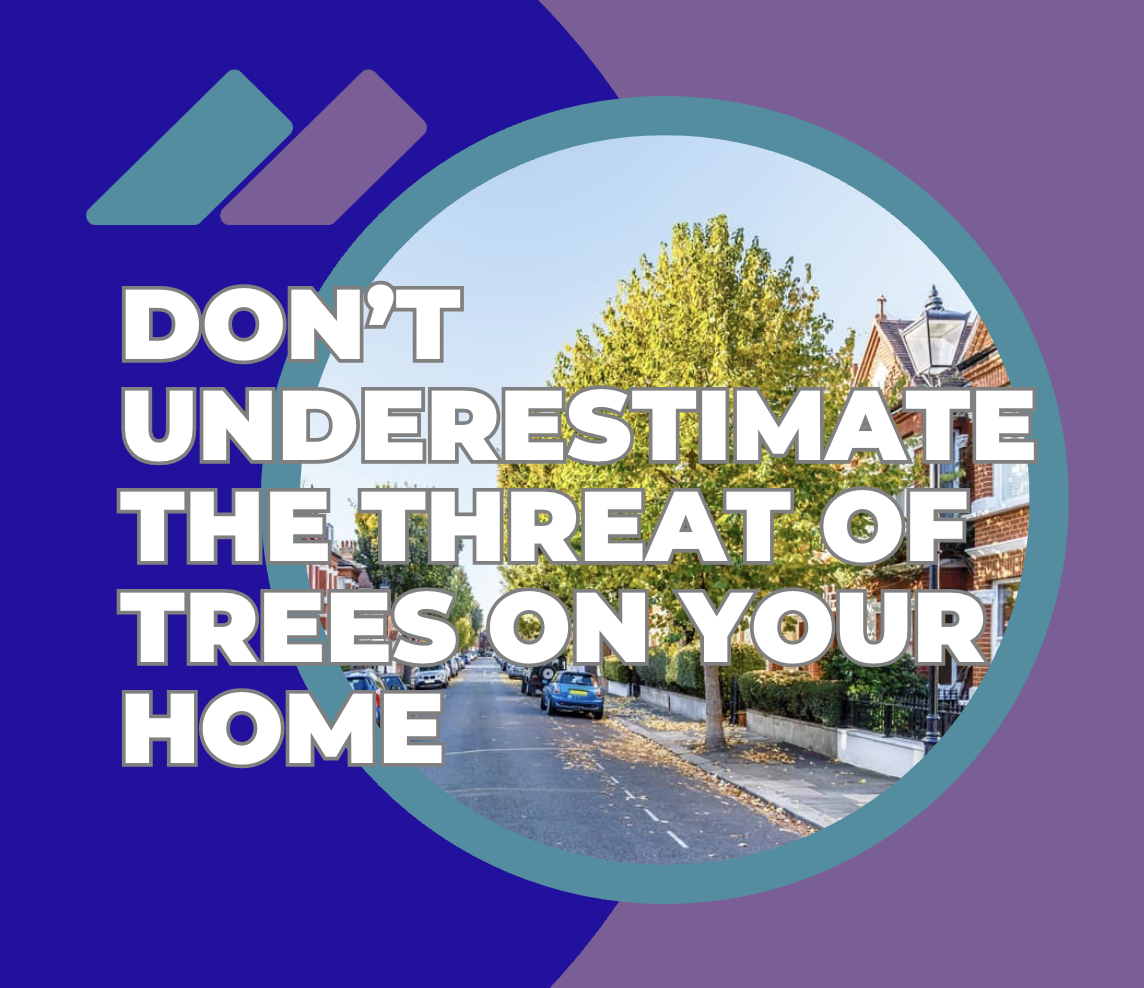
Trees can add beauty, privacy, maturity, and value to a home. They soften a streetscape, improve outlook, and are often seen as a desirable feature by owners and buyers alike. But while trees can enhance a property, they can also present a very real structural risk when planted too close to a building.
This is particularly true where mature trees sit near older homes, bay windows, boundary walls, paths, porches, or other elements that may not be founded as deeply or robustly as the main structure.
The risk is not always obvious at first. In many cases, the warning signs develop slowly and are dismissed as ordinary wear and tear until the movement becomes too significant to ignore.
WHY TREES CAN CAUSE PROBLEMS
The issue is not simply that a tree is present. The real concern is the relationship between the tree, the soil, the foundations, and the construction of the building.
Mature trees can influence ground conditions through root activity and moisture demand. Where a tree is close enough to a house, that influence can contribute to shrinkage, settlement, and movement in the surrounding soil. If part of the building is more vulnerable than another, the result can be differential movement, where one part of the structure moves at a different rate from the rest.
That is why features such as bay windows, front porches, paths, and low walls are often the first places where the effects become visible. They may have shallower foundations than the main house, or they may respond differently to changes in ground conditions. The consequence is cracking, distortion, and separation.
THE SIGNS HOMEOWNERS OFTEN MISS
Tree-related movement rarely starts with dramatic failure. More often, it begins with subtle signs that homeowners either overlook or explain away.
COMMON WARNING SIGNS INCLUDE:
- Cracking around bay windows and openings
- Gaps opening between skirting boards and floors
- Cracks to internal walls and ceilings
- Separation around window frames
- Movement to porches and steps
- Cracking and undulation to paths
- Cracking to boundary or retaining walls
- Signs of repeated repointing or patch repairs externally
- Evidence that previous cosmetic work may have been used to hide recurring cracks
These symptoms matter even more where they are clustered around the same side or elevation of a property, particularly if trees are located nearby.
A single crack may not tell you much on its own. A pattern of cracks, movement, distortion, and past making-good is far more significant.
WHY OLDER HOMES ARE ESPECIALLY VULNERABLE
Older homes are often more susceptible to this kind of issue because they were not always built in the same way as modern houses. Bay windows in particular can be vulnerable.
In many period properties, they may be founded differently from the main structure and may therefore respond more quickly to changes in the ground.
That means a homeowner may see significant movement around the bay and front wall while the rest of the house appears less affected. This can lead people to underestimate the seriousness of the issue, treating it as a local defect rather than a symptom of wider ground movement.
THE DANGER OF TREATING IT AS JUST A COSMETIC PROBLEM
One of the biggest mistakes homeowners make is assuming that cracks are purely decorative. It is common to fill, repaint, repoint, or patch over defects without understanding what is causing them. That may improve appearances temporarily, but it does not solve the underlying problem.
In fact, repeated patch repairs can be a warning sign in themselves. Historic repainting, repointing, or localised making-good may indicate that movement has been happening for some time and has simply been cosmetically concealed rather than properly investigated.
Where tree-related movement is involved, cosmetic repair alone is rarely enough. Unless the cause is understood and addressed, the defects are likely to recur.
WHY SURVEYORS AND BUYERS NEED TO TAKE TREES SERIOUSLY
Trees near a property should never be treated as a side note where visible movement is already present.
If a survey identifies cracking, distortion, undulation, previous repair, and mature trees in close proximity, those issues need to be considered together, not in isolation.
For buyers, this is especially important. A home survey should do more than list defects. It should help explain their likely significance and whether specialist advice is needed. Where the pattern of damage suggests a wider issue, further structural or arboricultural input may be essential before a buyer can properly assess risk.
THE POTENTIAL FINANCIAL IMPACT
Homeowners often underestimate the financial consequences of tree-related movement.
The cost is not limited to filling cracks and repainting. Depending on severity, remedial works can extend to structural stitching, helical reinforcement, rebuilding local sections, stabilisation measures, and in some cases underpinning, followed by extensive making-good and redecoration.
This is why early recognition matters. The sooner the issue is understood, the better the chance of managing it before the repair strategy becomes more invasive and expensive.
WHAT HOMEOWNERS SHOULD DO
If you have mature trees close to your home and are seeing cracking or movement, the right response is not panic, but proper investigation.
A sensible next step is usually to obtain professional advice from the right specialists. Depending on the symptoms, that may include a building surveyor, a structural engineer, and an arboriculturalist. The key is to establish:
- Whether the cracking is cosmetic or symptomatic of structural movement
- Whether the trees are influencing ground conditions
- Whether the building element affected is especially vulnerable
- What remedial strategy is actually appropriate
- Whether tree removal or management could itself create further risk, such as heave
That final point is important. Removing a problematic tree is not always a simple fix. In some cases, sudden removal can change ground behaviour again, so specialist advice should always come before action.
Getting the Right Advice
Trees can be one of the most attractive features of a home, but they should never be assumed to be harmless simply because they look pleasant or have been there for years. When mature trees stand close to a property, especially an older one, they can present a genuine structural threat.
The danger is not just in the tree itself, but in the combination of tree proximity, vulnerable construction, hidden ground movement, and a tendency to dismiss the early signs as minor. That is why homeowners, buyers, and surveyors alike should not underestimate the threat of trees on a home.
Purchasing a property and are concerned about cracks, trees or any other defect. If We can assist via our RICS Level 2, RICS Level 3 Surveys.
Own a property and are concerned about cracks, trees or any other defect. If We can assist via our Defect Analysis Report give us a shout today and we can advise the best route forward.