Party walls are a common feature across many homes in England and Wales, particularly in semi-detached, terraced, and converted buildings. As such, understanding what a party wall is and how it’s legally defined is essential before beginning any work that could affect a neighbouring property.
At Stokemont, we advise residential and commercial clients on the different types of party walls and the legal rights and responsibilities for each.
We’ll explain what a party wall is, the different types recognised by law, key ownership considerations, and how they differ from boundary walls and other shared structures.
What Is a Party Wall?
Simply put, a party wall is a dividing wall that forms part of a building structure and is built astride the boundary line of land belonging to two or more owners.
Section 20 of the Party Wall etc. Act 1996 defines a party wall as:
(a) a wall which forms part of a building and stands on lands of different owners to a greater extent than the projection of any artificially formed support on which the wall rests; and
(b) so much of a wall not being a wall referred to in paragraph (a) above as separates buildings belonging to different owners;
Party walls can fall into several interpretations, which can be confusing for those who have never come across the term ‘party wall’ or the Party Wall Act 1996 itself.
What Are the Different Types of Party Walls?
Party walls can take several forms, and understanding the different types helps clarify how the act applies in practice. The most common types of party walls are:
Type A Party Wall
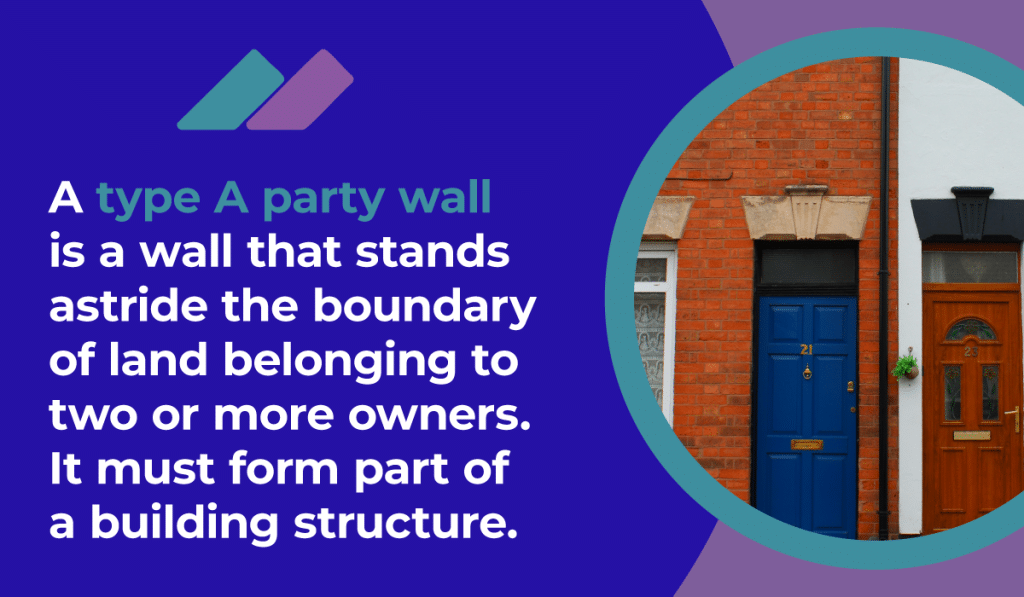
A type A party wall is a wall that stands astride the boundary of land belonging to two or more owners. It must form part of a building structure.
Common type A party wall examples include:
- Walls separating terraced houses
- Walls separating semi-detached properties
- Houses attached to a neighbouring owner’s garage structure
In each case, the wall is shared by adjoining owners and forms part of the structure of both buildings.
Type B Party Wall
A type B party wall is a wall that stands wholly on one owner’s land but is used by two (or more) owners to separate their buildings.
An example of this would be where a neighbouring owner has a structure, such as a newly constructed extension or garage, that has been enclosed against a wall owned by the adjoining owner.
In this instance, only the part of the wall that performs the separating function is considered a party wall, with any wall above or to the side not being treated as such.
The key point to note with a type B party wall is that the wall may not have been constructed as a party wall originally. Instead, it’s often a wall built up to the boundary line of one owner’s land, which later becomes a party wall when a neighbouring owner builds against it or uses it as part of their own structure.
From this point, the wall would typically be legally considered a party wall.
Party Fence Wall
Like a party wall, a party fence wall stands astride the boundary of land belonging to two or more owners. However, it differs in that it mustn’t form part of a structure, but instead extends from it.
To be legally considered a party fence wall, it must be a masonry wall (such as brick, stone, or block), shared by two owners, and positioned astride the boundary between their land.
Section 20 of the Party Wall etc. Act 1996 defines a party fence wall as:
‘A wall (not being part of a building) which stands on lands of different owners and is used or constructed to be used for separating such adjoining lands, but does not include a wall constructed on the land of one owner the artificially formed support of which projects into the land of another owner.’
An example of a party fence wall would be a wall between the gardens of two properties, acting as a single boundary feature. Due to the shared ownership of a party fence wall, both owners would attain equal rights under the Act.
As an exception, wooden fences, or even fences with concrete posts, are not deemed to be party fence walls.
What Is a Party Structure?
The Party Wall Act also uses the expression ‘party structure’. This term includes dividing structures such as floors, ceilings, or other shared partitions.
Section 20 of the Party Wall etc. Act 1996 defines a party structure as:
‘A party wall and also a floor partition or other structure separating buildings or parts of buildings approached solely by separate staircases or separate entrances.’
A party structure is more common in flat ownership, where an owner may want to remove, adjust, or improve shared partitions that may affect an adjoining owner. It’s uncommon that structures of this type would be a party wall matter, and it would more likely be handled by a Licence for Alterations agreement.
What Is the Difference Between a Party Wall and a Boundary Wall?
A party wall forms part of a building and is shared by adjoining owners, whereas a boundary wall may mark the division between two pieces of land and doesn’t necessarily form part of the structure (for example, a garden fence).
As such, only walls that meet the criteria set out under the Party Wall etc. Act 1996 will be subject to party wall procedures, protections, and obligations.
Who Owns a Party Wall?
In most cases, ownership of a party wall is shared between adjoining owners, with the boundary running through the centre of the wall. Each owner has rights and responsibilities to the section of the wall that supports or separates their property.
Where proposed works affect a party wall or structure, specific procedures must be followed, depending on the party wall works involved.
Responsibility for maintaining or repairing a party wall will depend on the cause of any defect and whether the issue arises from natural wear or construction-related works.
Where to Go for Party Wall Surveying and Advice
Party wall surveying procedures can be confusing at the best of times. Here at Stokemont, we are party wall specialists who provide expert advice to help you throughout the process.
If you would like to discuss party wall surveying with our team, contact us today, and we will be more than happy to assist and advise you.