Boundary surveying is one of the most misunderstood areas of property practice.
Many people assume that a boundary dispute can be resolved simply by looking at a Land Registry title plan and drawing a line where the red edging appears.
In reality, boundary surveying is far more nuanced.
A proper boundary assessment is usually a layered exercise that draws on:
- Title information
- Mapping evidence
- Historic records
- Site inspection
- Physical features
- Measurements
- Professional judgement
It also requires a clear understanding of what a surveyor can say, and what ultimately remains a matter for legal agreement or court determination.
BOUNDARY SURVEYING IS NOT THE SAME AS LEGAL DETERMINATION
A key starting point is this: a surveyor’s boundary report is not usually a legal determination of the boundary.
A surveyor can provide a professional opinion as to the likely position of the boundary based on the evidence available, but that does not, by itself, create a legally determined boundary.
In most cases, a final legal determination requires either agreement between the owners, formal Land Registry procedures, or court involvement. Good boundary surveying therefore sits at the junction of technical evidence and legal context.
This distinction is important because it shapes how the report is written. A competent boundary report will usually make clear:
- What the surveyor was instructed to do
- What was inspected
- What sources were reviewed
- What assumptions and limitations apply
- How the opinion has been reached
WHY TITLE PLANS ARE ONLY PART OF THE STORY
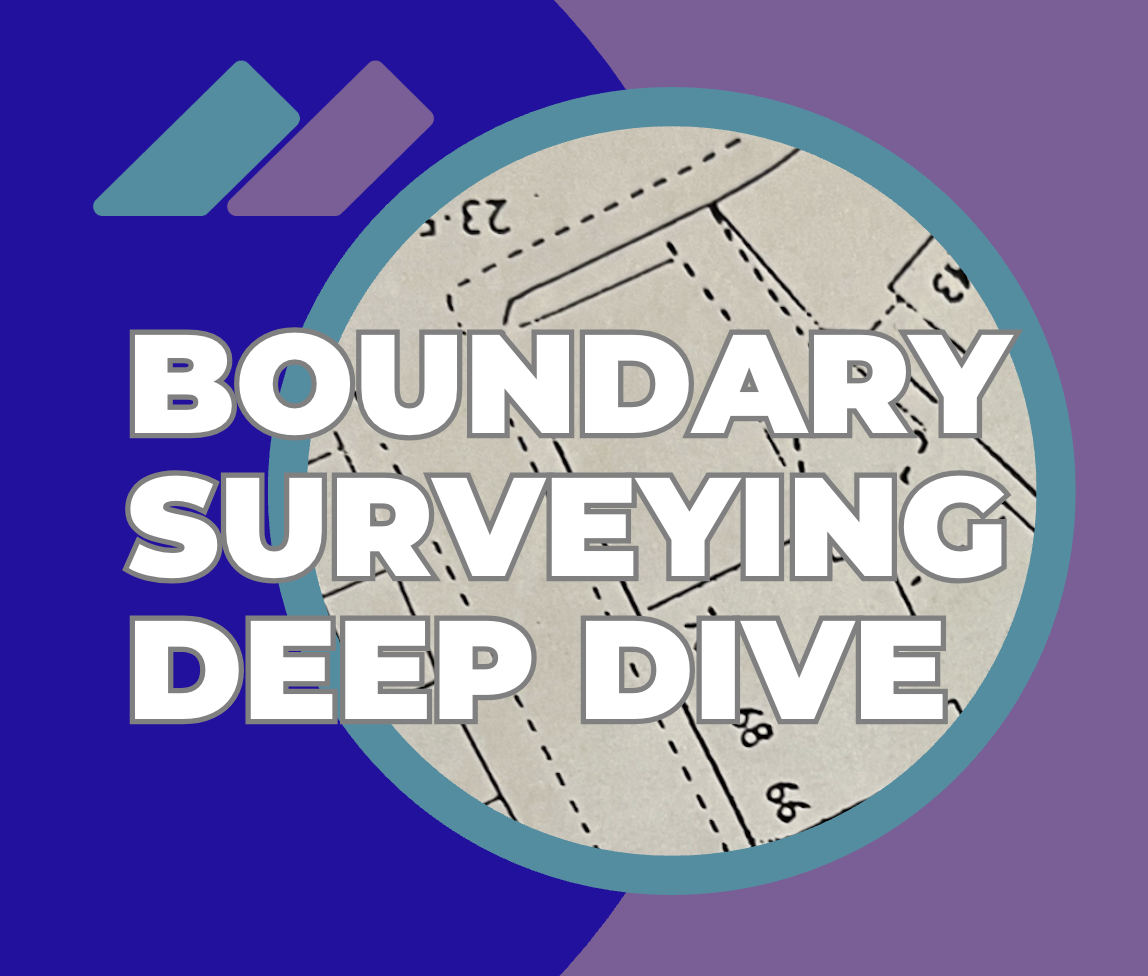
One of the most important principles in boundary surveying is that Land Registry title plans usually show only the general position of boundaries, not the exact line.
A good report should make this point directly and also note the problem of scale: where title plans are prepared at a scale such as 1:1250, attempting to scale measurements from them can produce materially inaccurate results.
This is a crucial lesson for owners and professionals alike.
A title plan may be helpful in understanding general alignment, but it is not usually precise enough to settle a close boundary question on its own.
That is why experienced surveyors do not rely on title plans in isolation.
THE IMPORTANCE OF LAYERED DOCUMENTARY EVIDENCE
A proper boundary survey often involves reviewing multiple categories of information, each with its own strengths and weaknesses. Common examples include:
- Land Registry title registers and title plans
- Ordnance Survey mapping
- Historic mapping
- Aerial imagery
- Planning application material
- On-site evidence
This layered approach matters because boundary analysis is rarely about a single “smoking gun” document.
More often, it is about whether several separate sources point in the same direction. When they do, the surveyor can express a firmer view. When they do not, greater caution is required.
1. CONVEYANCE PLANS
In boundary surveying, original conveyance or transfer plans are often among the most valuable documents, because they may contain detail that later title plans do not.
An important practical reality is that these older documents are often missing.
Where they cannot be located, the surveyor must proceed using secondary sources, while acknowledging that any newly discovered historic plan could affect the conclusion.
2. LAND REGISTRY RECORDS
Title registers can add important context beyond the plan itself. However, there are also common scenarios where the deeds and plans can offer no real insight into the matter at hand. That is where the surveyor’s expertise comes in.
3. ORDNANCE SURVEY AND HISTORICAL MAPS
Although Ordnance Survey maps do not determine legal ownership, they can still be valuable in showing how land and structures were historically laid out.
Historic maps may also help show whether a boundary alignment has long been represented in a particular way, especially where outbuildings, passages, walls, or other dividing features have existed for decades.
A good report uses these sources not as definitive proof, but as supporting indicators that reinforce the same overall alignment.
4. PLANNING RECORDS AND SITE PLANS
Planning records can provide another useful strand of evidence, particularly where submitted site plans reflect how a boundary was understood at the time of a planning application.
Again, these do not conclusively determine ownership, but they can be persuasive when they are consistent with other sources.
A well-considered boundary surveyor’s report treats them as part of a broader evidential picture rather than a standalone answer.
WHY THE SITE INSPECTION MATTERS SO MUCH
Boundary surveying is not just a desktop exercise.
A site inspection allows the surveyor to examine the physical layout on the ground and to identify what features are original, what has been altered, and what can sensibly be used as a reference point.
That is a vital part of professional judgement. Later changes such as render, cladding, decorative treatments, or other projections may distort the apparent position of a boundary if they are wrongly treated as part of the structural face.
MEASURED INSPECTION: WHERE PRECISION REALLY COMES IN
A good boundary report will often explain not just the conclusion, but also how measurements were taken.
A competent surveyor will usually set out the tools used, which may include a tape measure, an electronic laser measure, and a camera, and explain the repeated-check approach used to improve reliability.
More importantly, the report should apply those measurements consistently across different points on site. Where measurements taken between original wall lines remain closely aligned at the front, middle, and rear positions, that can support the conclusion that the relevant space maintains a consistent width and therefore supports a central boundary line or another clear boundary position.
ORIGINAL SURFACES VERSUS LATER ALTERATIONS
One of the most useful practical lessons in boundary surveying is the treatment of later alterations.
In boundary work, later surface finishes can be highly misleading. Render, insulation, decorative cladding, brick slips, over-sailing trims, and even poorly aligned extension elements can all make a wall appear further into a passage or boundary strip than the original structure actually is.
A careful surveyor will distinguish between original structural faces and later applied materials, and may exclude later finishes from boundary calculations where they do not form part of the original structural line. Equally, later projections or encroachments may need to be identified separately.
That distinction is critical. Boundary analysis often turns on whether one is measuring:
- The original building line
- A later finish
- A new projection or extension element
Treating those as the same thing can lead to the wrong answer.
SHARED ACCESS, RIGHTS OF WAY, AND THE PHYSICAL BOUNDARY
Another subtle point in boundary surveying is that ownership and access rights are not the same thing.
This is particularly common in older housing layouts. A passage may be divided by ownership, but subject to reciprocal access rights. Alternatively, part of it may be included in one title with rights granted to the other owner.
A surveyor therefore has to distinguish carefully between:
- Where the ownership boundary likely lies; and
- What rights may exist over the adjoining part
This is why boundary disputes in passageways, access strips, rear alleys, and shared drives can become so contentious. Even if the likely boundary line is identifiable, that does not automatically answer who may use the space and on what terms.
THE ROLE OF CONSISTENCY IN BOUNDARY OPINIONS
The strongest boundary opinions are not based on one isolated fact. Instead, they are supported repeatedly across:
- Title information
- Map evidence
- Historic mapping
- Aerial review
- Planning material
- Measured site inspection
In practice, that consistency is what often makes a boundary opinion persuasive. Where several independent sources all broadly support the same line, a surveyor can have greater confidence in the result.
WHAT A BOUNDARY REPORT SHOULD IDEALLY ACHIEVE
A useful boundary report should do more than say “the boundary is here.” It should also explain:
- Why that opinion has been reached
- What evidence supports it
- What evidence was unavailable
- What assumptions were necessary
- What practical implications follow from the conclusion
A well-prepared report may also go further by explaining how any future fence, wall, or fixing should relate to the inferred line, including the difference between a solely owned structure and one intended to sit astride the boundary.
That is a practical extension of the boundary opinion and often exactly the sort of guidance clients need.
Get the right surveyors on board. If you’re of the opinion you’re in a boundary dispute, perhaps your neighbour is suggesting you are. Make sure you instruct Boundary Surveyors who have both the experience and expertise to best assist.